Into the void
In my early DSP days, I had to address aliasing in my distortions. Like anyone starting out, linear oversampling was all I could access, as other solutions were too heavy in both math and CPU for my plugins.
Years passed, and when I joined NI, I had the chance to discuss this topic with my colleagues and friends Vadim Zavalishin and Mike Daliot. The status quo was that this was a well-known topic, already covered by people smarter than myself, and it had no perfect solution.
Locked down in Wuhan before it was cool
In 2016, I was in Wuhan with my wife and had to stay in a flat for a couple of days with not much to do. To keep my brain busy, I decided to think about the issue of aliasing. Due to my graphics background and way of thinking, I started picturing it as a geometrical problem to be solved. After a few sessions of just thinking it through, I decided to try and calculate the area of the space between two samples before and after they cross the threshold of a hard clipper.
The result was very satisfying. Right after that, I figured out that by recording the cumulative output of the function, I could store the values in a table. This table, when subtracted from the result of the same table over a consecutive sample input, would give me the area between the two samples for a nonlinear function that wasn’t just a clipper.
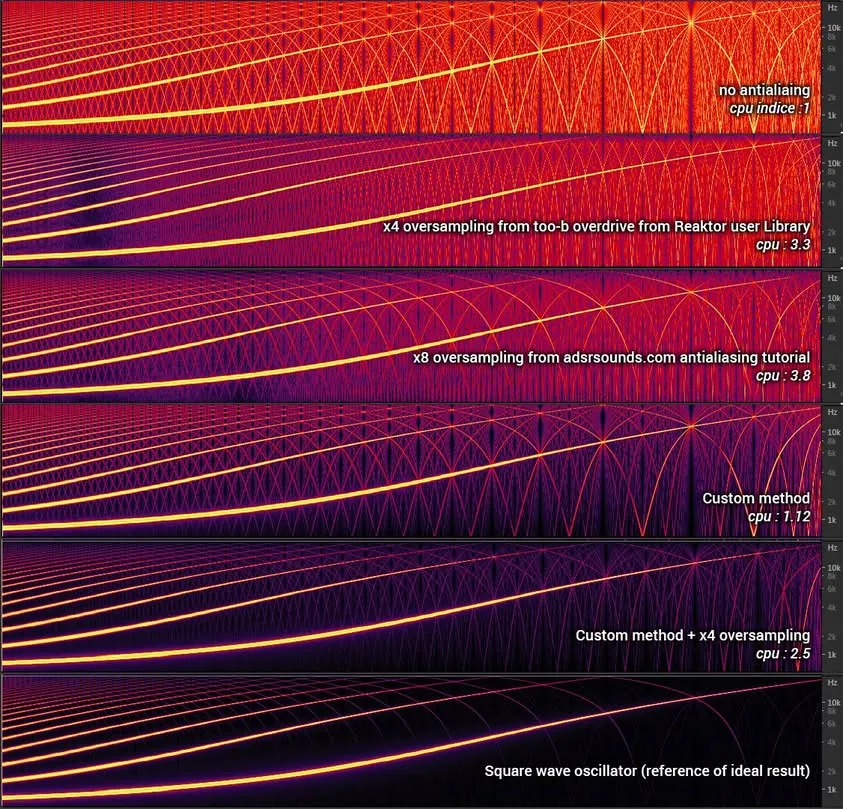
I later learned this was called an integral from my colleagues at NI, to whom I presented my results with great excitement on my way back.
All work displayed is copyright of their respective owners. Portfolio pieces are presented for the sole purpose of demonstrating my individual contribution and design process.